






THIS CONTENT IS BROUGHT TO YOU BY NTNU Norwegian University of Science and Technology - read more
The Nazis had "crazy" theories about the origins of the Sámi
Heinrich Himmler had an outlandish theory about where the Sámi came from.

Historian Andreas Eliassen Grini has delved into German soldiers’ descriptions of their experiences in Northern Norway. This includes their encounter with the Sámi culture.
A number of unexpected discoveries emerged, showing that the occupying power had a two-sided view of the Sámi population and culture.
On the one hand, the Sámi did not fit into the Nazi racial ideology. On the other hand, the Sámi’s close relationship to the natural world was something that was valued in Nazi ideology.
They found Northern Norway exotic
“What I found in the soldiers’ descriptions was that they experienced Northern Norway, and especially Finnmark, as very exotic. And by describing their surroundings and experiences as exotic, they created a distance for themselves from the actual acts of war in which they participated,” says Grini.
The descriptions mainly concern male fellowship out in nature. Almost like a kind of 'boys' trip' atmosphere.
“The Sámi culture is one of the elements that the soldiers experienced as exotic, which is something I’m exploring in my research,” he says.
Terra nullius – nobody’s land
World War II unfolded on many fronts. The Litsa Front, the northernmost part of the Eastern Front, was located in the border area between the Soviet Union and Finland. And Finnmark, Norway’s northernmost county, became an important base for German troops on this front.

The Litsa front and the surrounding area were defined in the German soldiers’ descriptions as nobody’s land – terra nullius. This gives their stories an expedition-like feel. The authors portray themselves and their fellow soldiers as explorers and polar adventurers:
'In no other area of Europe, not even in the high regions of the Alps, have the soldiers had so many difficulties to contend with due to the impenetrability of the terrain as in Lapland. The soldiers are equipped as if on expeditions.'
Along the entire coast of Finnmark and in many places in inland Finnmark, the occupying power built fortifications such as torpedo batteries, field artillery, cannons, and anti-aircraft defences. German soldiers operated throughout Finnmark during the war.
Grandiose beauty
The German soldiers were mainly so-called mountain troops, specialised in warfare in challenging climates and terrain, such as in Finnmark.
In their accounts, they highlighted both how tough and difficult the conditions were – and at the same time how beautiful the northern landscape was:
‘I became convinced that Norway in its grandiose, often wild beauty would not be surpassed by any of the countries of Europe.’
‘Barren aimlessness lies over this desolate wasteland. It is as if we are standing in front of an unfinished creation. Yet even the tundra has something uniquely beautiful to show.’
What role did the Sámi population play in the German accounts?
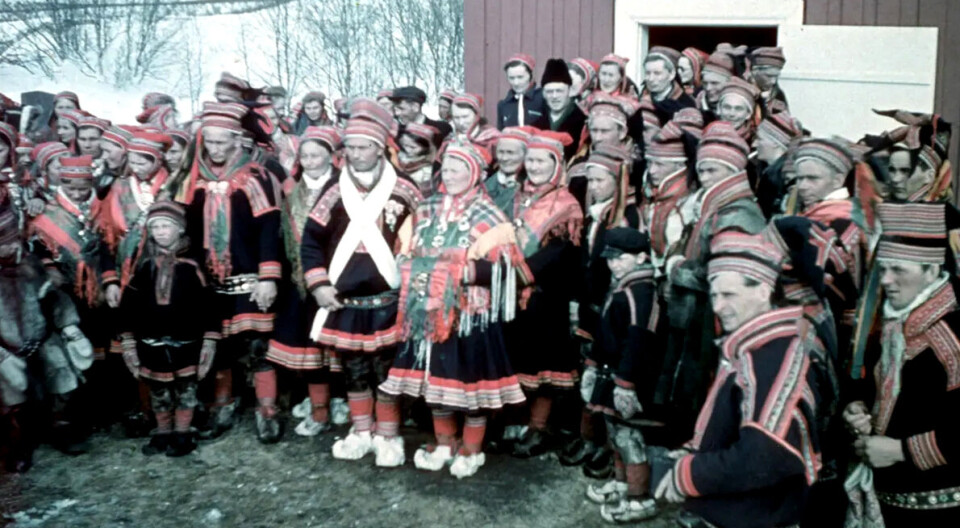
“The Sámi are often portrayed as ‘noble savages’ in an adventure-filled and foreign landscape. Their clothing, appearance, and behaviour contributed the soldiers' perception of the area as being wild and full of adventure,” says Grini.
An enigma and crazy theories
And where did the Sámi fit in the Nazi's racial ideology? The Sámi population and culture posed a kind of enigma for Nazi Germany.
“The Germans were generally focused on surveying where the different ethnic groups came from. They had an idea that the Sámi were of Asian origin, and Asians did not fit into the Nazi plan for a newly ordered Europe,” says Grini.

“At the same time, there were these crazy theories about the origins of the Sámi. For example, Heinrich Himmler toyed with the idea that the Sámi population had a connection with the sunken Atlantis,” he says.
According to legend, Atlantis was a rich island empire that sank into the sea.
The Sámi population was therefore a puzzle for the Germans, who had a two-sided relationship with them.
“The Germans perceived the Sámi as living at one with nature – and proximity to nature was something that was cultivated in Nazi ideology,” says the researcher.
The Sámi bond to nature was central. After a visit to Norway in 1941, Heinrich Himmler said that the Sámi should be allowed to live more or less undisturbed on their own terms in Finnmark.
Advocated for the preservation of the Sámi language
Both German and Norwegian National Socialism had diverse attitudes towards the Sámi.
"However, German Nazis seem to have been less critical of Sámi cultural practice than the Norwegian pre-war authorities,” says Grini.
The Norwegianisation of the Sámi started as early as the mid-1800s, and was a policy that promoted assimilation.
“But we can see a shift during the war which consisted of a transition from assimilation to segregation, probably inspired by German racial ideology,” the researcher says.

Grini describes an example where the Norwegian NS authorities introduced fishing rights only for Sámi in certain fishing lakes in Nord-Trøndelag. Another example is Minister of Culture Guldbrand Lunde, who wrote an article in Norwegian newspapers where he called for strengthening the Sámi language in schools.
“There was a tendency in the attitudes that the Sámi should be allowed to exist on their own basis,” says Grini. He thinks there are a two possible explanations for this:
- To preserve Sámi identity and culture.
- To avoid the mixing of Norwegian and Sámi genes (ethnic groups should be kept separate).
A diversity of meeting places
How did the Sámi relate to the German soldiers? Grini describes different arenas and relationships between German soldiers and Sámi:

Through reindeer herding
Reindeer herding quickly proved to be an invaluable resource for the occupying power. The German army used reindeer in its daily operations, as well as in combat situations, as a source of food, clothing, and transportation.
This led to both trade related to reindeer herding, as well as conflicts through German requisitions.
One of the more dramatic stories was when a handful of Sámi reindeer herders managed to evade Police Minister Jonas Lie’s order to evacuate Finnmark. In doing so, they saved a large portion of Finnmark’s reindeer.
Through love affairs
Early in the occupation, German soldiers were explicitly forbidden to marry Sámi women.
Nevertheless, several children were born through love affairs between German soldiers and Sámi women.
Many of the sources here are still restricted, and there are stories that must be handled carefully, as they may still be painful for descendants.
Through German soldiers’ documentation of Sámi life:
It seems that the fascination for Sámi life and culture persisted throughout the war years.
As a result, the Sámi were frequently photographed by and with German soldiers.
Many of these photographs can be found in private German albums and in letters and postcards sent to Germany with motifs from Sápmi.
Resistance, collaboration, and grey areas
There were also Sámi soldiers who participated in Norwegian military units, especially in the Norwegian Alta battalion, which fought against the Germans in Narvik.
And it was the Sámi who made a major contribution to the resistance movement, often as guards on the Swedish border.
“But there were also Sámi who collaborated with the Germans, and Sámi who joined the NS, a topic that hasn’t been studied very much. It seems that the Sámi population, like the Norwegian population in general, cannot be said to have formed a closed front against the occupying power,” says Grini.
This is sensitive material that the researcher is now examining more closely. As part of the work, Grini has therefore maintained regular contact and collaboration with Sámi institutions.
Examples include Karasjok University College, Saemien Sitje in Snåsa, and Sitji Jarnge in Hattfjelldal, both of which are museums and centres for Sámi language and culture.
“I’ve gotten a wide range of reactions to the project. At times, and understandably, it's probably perceived as challenging that I bring up material related to treason cases and war children,” he says. “On the other hand, I have received positive reactions where people express a desire for a complete Sámi war history to be written, which also includes the painful stories.”
References:
Grini, A.E. Es war ein Edelweiss. Die Nordfront in den Memoiren der Gebirgsjäger der Wehrmacht (It was an edelweiss. The Northern Front in the memoirs of the mountain troops of the Wehrmacht), Zeitschrift Zeitgeschichte, 2025.
Grini, A.E. Es war ein Edelweiss. Selvforståelse og -konstruksjon i krigsmemoarer fra Wehrmachts 2., 3. og 6. Bergjegerdivisjon (It was an edelweiss. Self-understanding and construction in war memoirs from the Wehrmacht’s 2nd, 3rd and 6th Mountain Fighter Divisions), Master thesis at NTNU, 2022.
German sources from the Reichskommersariet and the Wehrmacht
Norwegian sources: Lapp bailiffs and reindeer herding agronomists, both of whom were links between the Sámi and the Norwegian state. These sources have not been studied much in the past.
The Treason Archive: In this archive, there are still a number of documents that are restricted and where access is granted on the basis of an application. However, application-free access is allowed if the person in question was born more than 120 years ago.
———
Read the Norwegian version of this article on forskning.no

More content from NTNU:
-
Why making lighter and better batteries takes time
-
Professor: Why we should expect cyberattacks during major events
-
Migraines leave traces throughout the body that researchers can now detect
-
Insect expert hunts for unknown life in New York
-
No, your family relationships don’t get worse even if you spend a lot of time on social media
-
Can artificial intelligence help save nature?


