






THIS CONTENT IS BROUGHT TO YOU BY NTNU Norwegian University of Science and Technology - read more
Physicists may have found the missing link for quantum computers
Many physicists are searching for a triplet superconductor. It could provide lightning fast computers that use almost no electricity.

Triplet superconductors are the key to achieving the most efficient technology in the future.
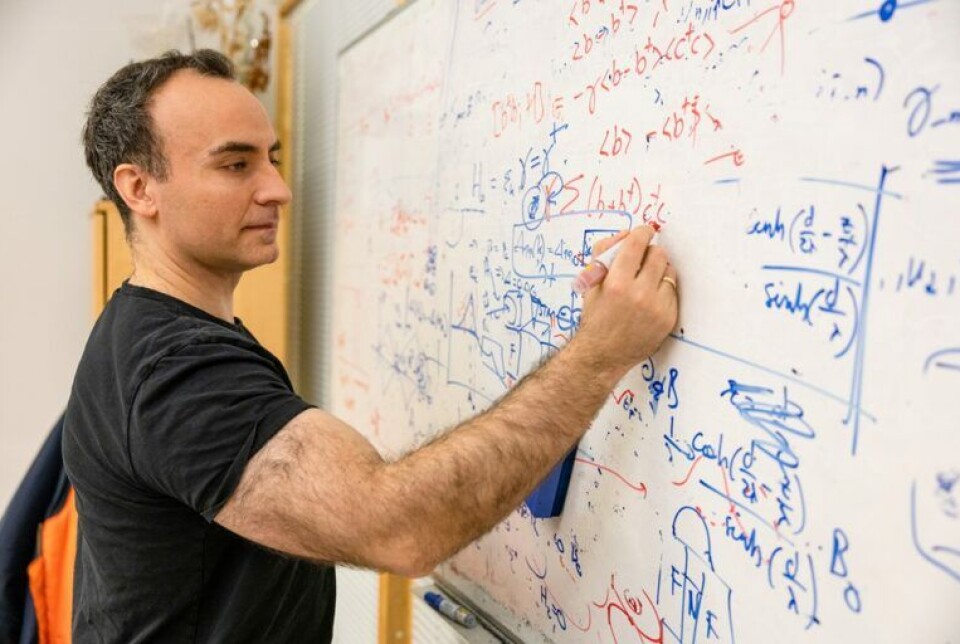
“A triplet superconductor is high on the wish list of many physicists working in the field of solid state physics. Materials that are triplet superconductors are a kind of holy grail in quantum technology, and more specifically quantum computing,” says Professor Jacob Linder.
He works at NTNU’s Department of Physics.
He and his colleagues are now on the trail of this triplet superconductor.
“We think we may have observed a triplet superconductor,” says Linder.
Making unstable technology stable
Linder and his colleagues work with quantum physics in materials and how it can be used in spintronics and quantum technology.
The short version is that spin is a property of electrons that we can use to transfer signals in ways different from today’s ordinary computers.
See a more detailed explanation in the fact box below:
Spin can also be used in quantum technology, especially when combined with superconductors, but the current technology is frustratingly unstable.
“One of the major challenges in quantum technology today is finding a way to perform computer operations with sufficient accuracy,” explained Linder.
And that is where a triplet superconductor comes in.
“Triplet superconductors make a number of unusual physical phenomena possible. These phenomena have important applications in quantum technology and spintronics,” says Linder.
Superconductors versus triplet superconductors
Conventional superconductors can transfer current – electrons – without measurable electrical resistance. This is very useful, but not always efficient enough.
- Conventional superconductors are so-called ‘singlet superconductors.’ In simple terms, this means that the superconducting particles do not have spin.
- In triplet superconductors, however, the superconducting particles have spin.

So, what does this mean?
“The fact that triplet superconductors have spin has an important consequence. We can now transport not only electrical currents, but also spin currents with absolutely zero resistance,” says Linder.
This means that extremely fast computers can be operated using almost no electricity at all.
If physicists discover a triplet superconductor, it will be possible to transmit information using spin – without losing any energy.
NbRe is promising for triplet superconductors
“In our published article, we demonstrate that the material NbRe exhibits properties consistent with triplet superconductivity,” says Linder.
NbRe is a niobium–rhenium alloy. Both metals are rare.
“It's still too early to conclude once and for all whether the material is a triplet superconductor. Among other things, the finding must be verified by other experimental groups. It's also necessary to carry out further triplet superconductivity tests,” the researcher says.
Still, he remains hopeful.
“Our experimental research demonstrates that the material behaves completely differently from what we would expect for a conventional singlet superconductor,” he says.
Works at relatively high temperatures
“Another advantage of this material is that it superconducts at a relatively high temperature,” says Linder.
The researcher probably has a somewhat different perspective on what a high temperature is compared to most people.
In this context, high temperature means 7 Kelvin, which is just above absolute zero at -273.15 degrees Celsius.
According to the researcher, other possible candidates for triplet superconductivity require around 1K, and in that context 7K is almost tropical and highly achievable.
Reference:
Colangelo et al. Unveiling Intrinsic Triplet Superconductivity in Noncentrosymmetric NbRe through Inverse Spin-Valve Effects, Physical Review Letters, 2025. DOI: 10.1103/q1nb-cvh6
———
Read the Norwegian version of this article on forskning.no
More content from NTNU:
-
Why making lighter and better batteries takes time
-
Professor: Why we should expect cyberattacks during major events
-
Migraines leave traces throughout the body that researchers can now detect
-
Insect expert hunts for unknown life in New York
-
No, your family relationships don’t get worse even if you spend a lot of time on social media
-
Can artificial intelligence help save nature?


